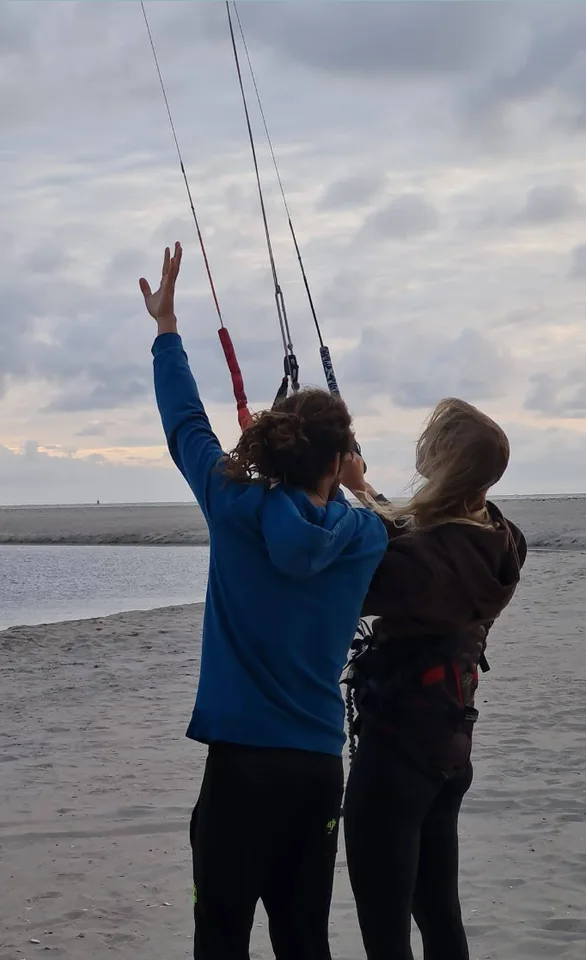

The first question we get on WhatsApp isn't how much a kitesurf lesson costs; it's something far more important: "Is it windy today?" In Málaga there is no simple yes or no. Here the wind changes name, direction and intensity within hours. If you understand that, you'll understand why at Isobaras we don't tie ourselves to one beach.
Levante and poniente: Málaga’s two winds
Two main winds coexist on the Costa del Sol. The levante blows from the east, from the Mediterranean, and usually arrives stronger east of Málaga, especially in Rincón de la Victoria. It's a thermal wind that strengthens in summer and, when it comes in clean, allows long, fun sessions without huge waves.
The poniente comes from the west and is the ally of Torremolinos and Marbella. It tends to be more stable, with even gusts, making it ideal for anyone learning to control the kite for the first time. When the poniente blows hard, Torremolinos becomes our favourite training ground.
How to read the forecast in three steps
- Direction: check where it's blowing from. On Windy or Windguru, levante shows as E/SE and poniente as W/SW.
- Average gusts: don't look only at peak speed. For beginners we look for 12–20 knots average.
- Sun hours: the levante thermal wind strengthens with midday heat. Sometimes there's nothing at 10:00 and by 14:00 it's perfect.
"There's no bad wind, just the wrong spot. That's why we move."
Why do we switch spots?
Each beach on the Costa del Sol faces a different direction. The same wind direction can be offshore in one place and side-onshore in another. That changes everything: wave shape, launch safety, room to practise. At our kitesurf school in Málaga we check the forecast every morning and decide where to set up so your session works out.
If you're visiting and don't know the spots, don't worry. You book; we read the map. That's the advantage of a mobile club: wherever the wind is, we'll be there.